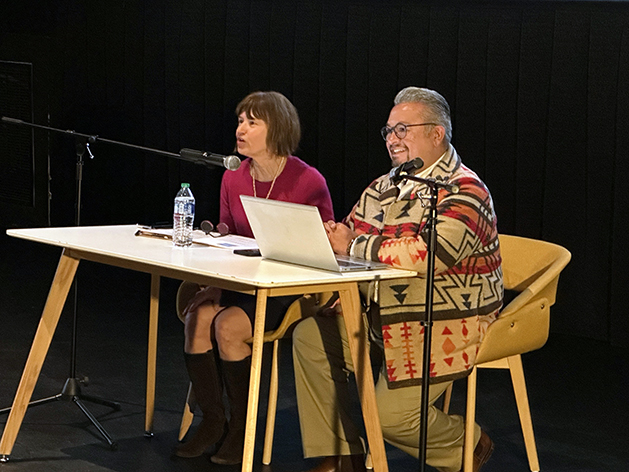
 Rep. Christine Chandler and Sen. Leo Jaramillo discuss the 30-day Legislative Session, which ended Feb. 15, during the Los Alamos Chamber of Commerce Business Breakfast Feb. 29 at SALA Event Center. Photo by Kirsten Laskey/ladailypost.com
 Participants at the Los Alamos Chamber of Commerce Business Breakfast Feb. 29 at SALA Event Center. Photo by Kirsten Laskey/ladailypost.com
By KIRSTEN LASKEY
Los Alamos Daily Post
kirsten@ladailypost.com
The 30-day New Mexico legislative session, which ended Feb. 15, may be primarily for passing the budget and other revenue issues, but a variety of bills came before the House and Senate.
Rep. Christine Chandler and Sen. Leo Jaramillo offered highlights about the recent legislative session to Los Alamos Chamber of Commerce members during the Chamber Business Breakfast Feb. 29 at the SALA Event Center.
Chandler provided a brief overview of the entire session.
“We passed a budget that is greater than $10 billion,” she said. “That’s historic in terms of size. I think it represents about a more than 6 percent increase in spending from last year’s budget.”
She emphasized the state is aware that its spending habits cannot go on indefinitely. Oil and gas revenues are projected to decrease in seven to eight years and the state is preparing for lower revenues.
For instance, it does have a significant amount – $3 billion – in reserves. Additionally, Chandler said monies are being put away for different priorities so when the revenue tapers off the state will have access to those funds. Furthermore, she said a bill was passed last year that increases investment in the severance tax fund and the state does have a “rainy day fund” to address any shortfalls in the budget.
“There were a wide range of bills that we passed this year,” Chandler said. “The budget is still very healthy and will continue to be, I think, into the near future.”
Both legislators discussed bills they sponsored and co-sponsored.
Chandler mentioned that there was a lot of focus on environmental issues such as electric vehicles, renewable energy generation and storage.
For her part, Chandler sponsored a bill that gives municipalities and counties authority to negotiate Industrial Revenue Bonds for energy storage facilities as they can for solar and wind production projects and renewable energy transmission facilities. Also, the bill would provide gross receipt tax deduction for sales of energy storage equipment to local governments. Chandler said she also co-sponsored a bill for clean transportation fuel standards.
Jaramillo said last year his major initiative was to ensure every student in New Mexico had access to free breakfast and lunch, which are not just processed foods but produce from local farms. Now, he said other states are following suit.
“We are fully funding right now New Mexico’s universal free school meal program on a recurring basis ensuring every New Mexico student can focus on their studies and not on their stomachs,” Jaramillo said.
The state is not just ensuring young people are fed, but older citizens, too. Jaramillo said seniors will see an increase in their SNAP benefits – which will rise from $25 a month to $100 a month.
While it didn’t pass this session, Jaramillo’s proposal to establish a Fentanyl Poisoning Awareness Week in October to educate students on the dangers of fentanyl kicked off the discussion.
He also introduced a bill for school drug education, in which for one week outside entities would be brought to school districts to discuss the dangers of opioids.
He also touched on capital outlay funds that were awarded including $300,000 for the Jemez Mountain Fire Protection pipeline project, $150,000 for roof repairs at the University of New Mexico-Los Alamos and $100,000 was approved for the Council of Governments to use for grant writers. Locally, a grant writer will be tapped to address the Los Alamos High School Eco Club’s request for an electric bus, Jaramillo said.
During the question-and-answer period, Los Alamos County Councilor Suzie Havemann asked about an initiative to bring financial literacy requirements to public education.
Jaramillo said he supported the bill that proposed this initiative during the legislative session.
“I had a number of parents who reached out and talked about how their students in middle school think debit cards have an endless amount of money (and) you can go to any ATM … they really talk about how there is no real financial literacy when you come into the school setting … then they go on to a college campus and they are offered a credit card and you think the world is your oyster,” he said. “You don’t think about interest rates, you don’t think about monthly payments. I supported that bill … the bill will make its way back next session. Even the Public Education Department Cabinet Secretary supported the bill and I think everyone as parents and even those in the banking industry can agree that financial literacy is something that is important (and) that you should teach at an early age.”
Chandler said given that schools have limited curriculum and limited time, she was leery about adding one more thing.
“… we still have some basic education we have to be doing in the schools and as we move forward we have to be mindful of that,” she said, noting that New Mexico’s reading and math scores are not great and teaching financial literacy is something parents should be doing, too.
Havemann also asked about what was being done as far as economic development in preparation for when oil and gas revenues begin to fall.
Economic development is always hard, Chandler said. It takes a while to induce companies to come to the state and a trained and educated workforce is key.
When asked about what is being done to address young people’s mental health, Chandler and Jaramillo agreed that there is a lack of resources and facilities.
Although Chandler said financial assistance is offered to train mental health providers such as social workers.
Another question was posed regarding the housing needs in the state.
Jaramillo pointed out a Senate bill for the Mortgage Finance Authority affordable housing project that amends the New Mexico Finance Act by adding housing as a public project that is eligible for financing and adding nonprofit housing developers as qualified entities. The bill also adds affordable housing plans as qualified housing for local government planning funds.
Chandler noted that the House also passed a bill that supports housing.
“The state is stepping up in terms of providing funding for rehabilitation as well as new housing stock,” she said. “It’s definitely high on the radar…”
The 30-day session is a jam-packed period and while it has highs and lows, Jaramillo emphasized that “It was an honor representing all of you.”