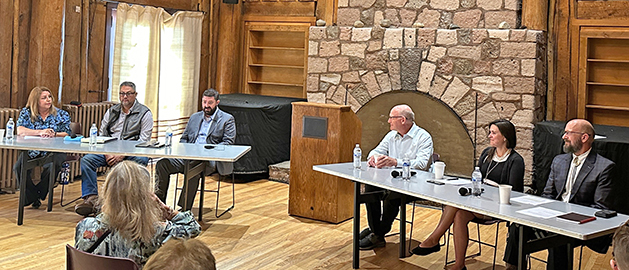
 Los Alamos County Intergovernmental Affairs Manager Danielle Duran, left, moderates a panel focused on STEM education Tuesday morning at Fuller Lodge. The panelists included second from left, Pueblo de San Ildefonso Lt. Governor and Director of Environmental and Cultural Preservation Raymond Martinez, Principal Deputy Assistant Secretary of the DOE Office of Environmental Management Jeff Avery, Los Alamos County Department of Public Utilities Manager Philo Shelton, Environmental Management-Los Alamos Field Office Deputy Manager Ellie Gilbertson and N3B President and General Manager Brad Smith. The panel was part of this year’s ScienceFest. Photo by Kirsten Laskey/ladailypost.com
By KIRSTEN LASKEY
Los Alamos Daily Post
kirsten@ladailypost.com
An education in science, technology, engineering and mathematics (STEM) can lead a person on any career path and toward endless opportunities.
This sentiment was heavily emphasized during a panel discussion Tuesday morning at Fuller Lodge.
The discussion, which was part of this year’s ScienceFest, featured the following panelists:
- Principal Deputy Assistant Secretary of the DOE Office of Environmental Management Jeff Avery;
- Environmental Management-Los Alamos Field Office Deputy Manager Ellie Gilbertson;
- N3B President and General Manager Brad Smith;
- Pueblo de San Ildefonso Lt. Governor and Director of Environmental and Cultural Preservation Raymond Martinez; and
- Los Alamos County Department of Public Utilities Manager Philo Shelton.
Los Alamos County Intergovernmental Affairs Manager Danielle Duran moderated the discussion.
Throughout the talk, the conception that STEM education confines people to the subject matters listed in the acronym was dispelled as was the type of person who could be successful in a STEM field.
People do not have to be an A+ student or a member of the National Honor Society to be successful in STEM, Avery said.
“There are many different pathways to success,” he said.
Shelton spoke of one such pathway. He recalled a custodian at Fuller Lodge who was interested in computer science. She joined the Department of Public Utilities Customer Care Service and the department paid for her continued education. Her efforts achieved a mobile application that serves as an interface between utility customers and the workers.
“One of things I’ve seen throughout my career … (is) keep your eyes open, you have people that are in your team that may be able to transition to help you in the STEM fields,” Shelton said.
It is not just limited to mathematics or science, the applications are widespread, as Martinez pointed out. STEM can be a great tool in addressing Pueblo’s traditional and cultural needs, he said.
“…I’ve been in a role in our leadership system so being able to have that understanding of what it takes to have traditional, cultural things (that) we need to get done to be able to practice – that is STEM,” he said.
Martinez noted it also benefits the Pueblo and the Los Alamos National Laboratory in identifying historical and cultural sites in relation to LANL’s cleanup efforts.
“We are the ones who have that knowledge (and) by knowing where the sites are, what they’ve gone through, what they’ve had to endure and by having that communication, maybe we let them rest … no more disturbance.”
But if the site is disturbed, the Pueblo can explain what the repercussions would be, Martinez said.
As a result of the endless applications for STEM, all the panelists said there are a lot of efforts to support and encourage STEM education.
“You got to let them know what’s there,” Gilbertson said. “You got to broadcast that … particularly (to let) the young folks know what’s available.”
She added one of the things EM-LA has done is partner with the Hive. This helps EM-LA identify collaborators that offer STEM services. Hive, Gilbertson said, works directly with high school and middle school students to offer things like youth coding leagues and computer programming. It also provides work force development workshops, career fairs and internship fairs.
“There are so many services that the Hive is able to offer the community and that is because we are able to fund that and support that,” Gilbertson said.
Smith said N3B tries to be as accessible as possible whether that is running a bootcamp for nuclear operators or approaching people outside of the laboratory workforce about a career at N3B.
“We all started without being where we are at today,” he said. “It’s because somebody took us under their wing and helped us.”
It also takes realizing not everyone has all the tools to be successful and needing to respectfully accommodate them, Smith said.
“If someone feels ashamed because they are impoverished, how do we make it acceptable so we’re not demeaning them asking the question, but it is asked in a way that makes them feel welcome …,” he said.
Avery added that on the federal level, the Environmental Management office is doing everything it can to add to its workforce.
“We are using every tool that we have available to us in the toolkit,” he said.
These tools include EM Pathways, which is for students and recent graduates to be introduced to the EM programs and careers. He added that EM also offers a partnership program—the Minority Serving Institutions Partnership Program—by collaborating with colleges for interns and recent graduates to get hands-one experience at DOE laboratories. In fact, just this year, $25 million was awarded in grants to higher education institutions across the country to take part in the program, Avery said.
Martinez said the Pueblo de San Ildefonso takes advantage of any opportunity it can to support STEM education in the Pueblo.
“For us at the Pueblo San Ildefonso we have been fortunate in growing our relationship with the laboratory,” he said. “We’ve taken advantage of folks up here on the hill coming down and teaching our kids, mentoring our kids, having after school programs with our kids. We had some of the scientists up here come down and tutor our kids, help them … that opportunity was provided to us by opening these doors for communication. We’ve taken full advantage of that and have that relationship grow.”
He added it is important that the Pueblo leaders broadcast what opportunities in STEM are available.
“It’s up to us as leadership to communicate those opportunities to our youth,” Martinez said. “There are opportunities out there you just need to be aware of it … That’s my job to get that out there.”
Smith said it is important to make sure all opportunities are available to those who are interested.
“If the opportunity is there and they feel they can be part of it … we have to make it available to them,” he said.