 Santa Fe Symphony News:
The first performance of the Ninth took place in Vienna on this day, May 7, 1824, when Beethoven was 53. He had been deaf for years, but he sat on stage with the orchestra and tried to assist in the direction of the music. This occasion produced one of the classic Beethoven anecdotes. Unaware that the piece had ended, Beethoven continued to beat time and had to be turned around to be shown the applause that he could not hear; the realization that the music they had just heard had been written by a deaf man overwhelmed the audience.
Beethoven’s Ninth is at once his grandest symphony and his most challenging, and its challenges have been both moral and musical. The unprecedented grandeur of Beethoven’s music, the first use of voices in a symphony, and in particular the setting of Schiller’s “An die Freude” have made the work one of the great statements of romantic faith in humankind, a utopian vision of the universal bond of all people.
The Ninth seems so perfectly conceived that it comes as a surprise to learn that it took shape very slowly over a span of 30 years, and Beethoven’s conception of the music changed often during that process. He first planned to compose a setting of Schiller’s “An die Freude” as early as 1792, when he was just 22 (Schiller had written that ode seven years earlier). Although he set that intention aside, the idea remained with him and was not mentioned again until 20 years later, when Beethoven noted such a plan in his sketchbooks. An invitation from the London Philharmonic in 1817 to write two symphonies finally prodded the composer to action (although the London visit never took place). The Ninth was completed in early 1823.
In a world that daily belies the utopian message of the Ninth Symphony, it may seem strange that this music continues to work its hold on our imagination. It is difficult for us to take the symphony’s vision of brotherhood seriously when each morning’s headlines show us again the horrors of which man is capable. Perhaps the secret of its continuing appeal is that for the hour it takes us to hear the work, the music reminds us not of what we too often are, but of what, at our best, we might be. —Note by Eric Bromberger
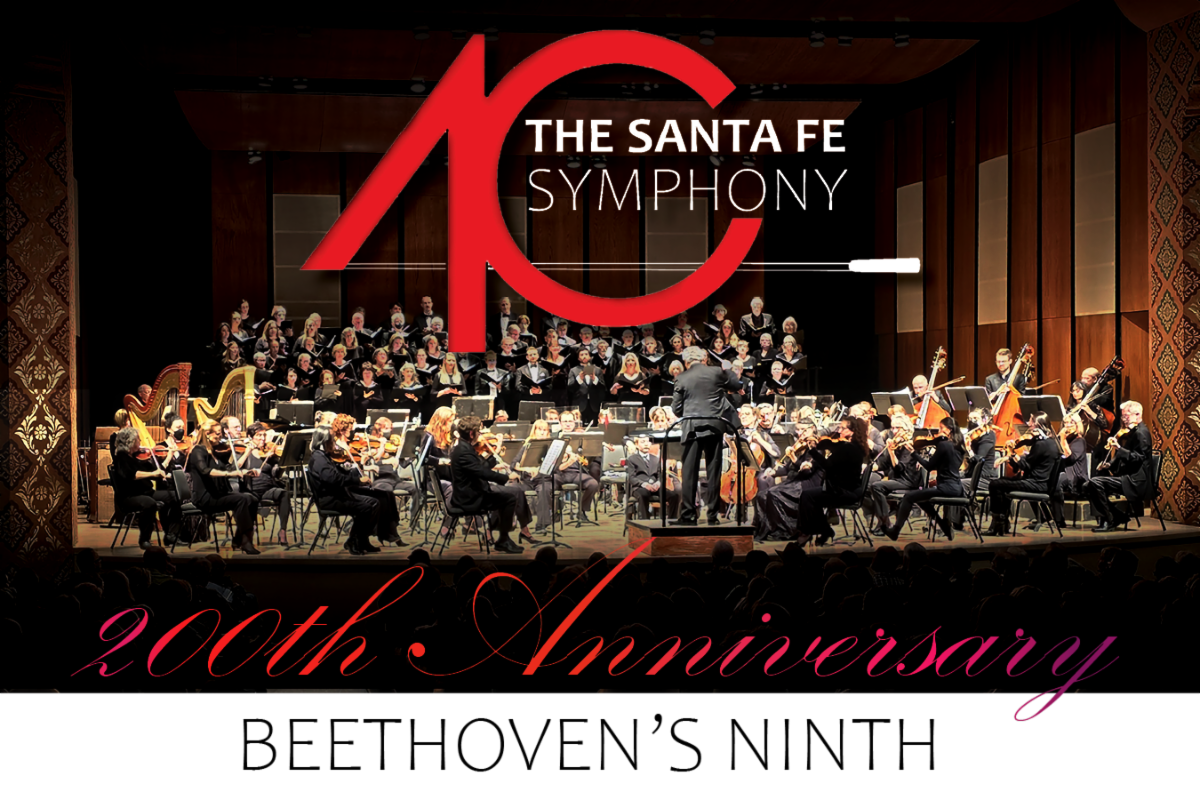
The Santa Fe Symphony will perform Beethoven’s Ninth to a sold-out audience May 19 at the Lensic in Santa Fe.