 By NELLY MAUDE CASE
Los Alamos
Los Alamos County has returned from “Set” to “Ready” in relation to the Cerro Pelado wildfire evacuation protocol. The blaze is now 62 percent contained, thanks to the efforts of over 1,000 firefighters.
The cause of the fire, which began on April 22 and has consumed well over 45,000 acres, has still not been determined, but after a week’s closure, schools are back in session and life in general is slowly returning to normal.
My daughter Susannah and her fiancé Jaymes will fly into Santa Fe the day after tomorrow, and the wedding weekend should go forward pretty much as planned, although smoke from the much larger Calf Canyon/Hermits Peak Fire northeast of Santa Fe may make an outdoor ceremony impossible. That decision won’t be made till this weekend.
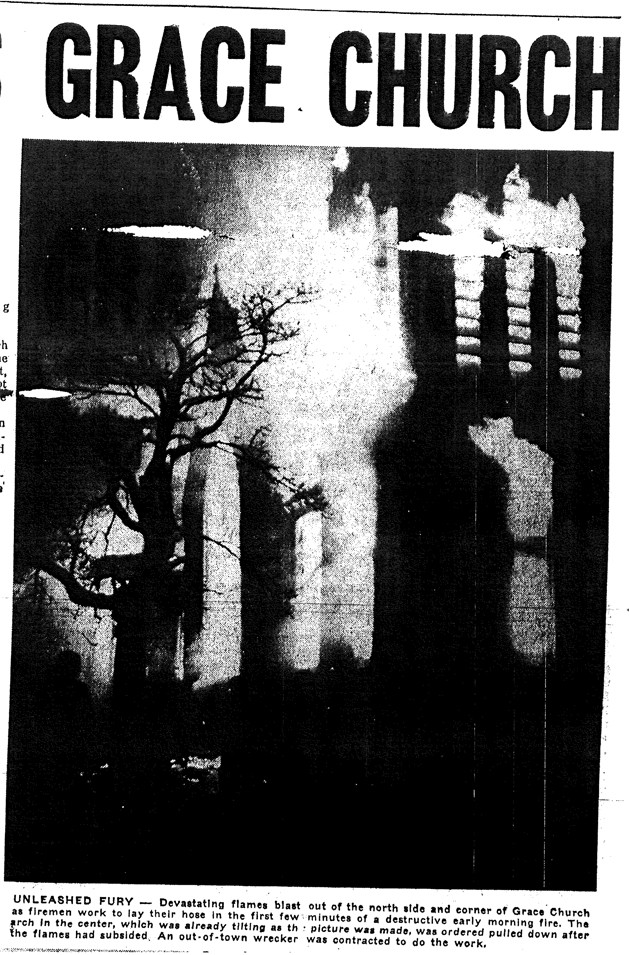 Another Washington C. H Record–Herald photo of the fire at Grace Methodist Church, Jan. 14, 1959. Courtesy photo
Meanwhile, most people here are breathing a huge sigh of relief.
In any case, I’m still fascinated by Helga’s letters. Early on, she offered to teach me some German, for example, “Guten Tag” meaning “Good Day,” “Gute Nacht,” for “Good Night,” and “Auf Wiedersehn,” meaning “Goodbye,” or more literally, “Until I see you again.” I wouldn’t fully comprehend that last expression until I studied German in graduate school around 1980. She was surprised that I didn’t have to go to school on Saturdays as she did. She also sent me a copy of her weekly class schedule, which included classes in geography, history, religion, swimming, dancing, and biology as well as English, German, art and needlework. She said she felt lucky to have a “pen–friend in America,” even though I clearly didn’t write to her as often as she hoped I would. Helga decorated many of her letters with colorful drawings, and over time she sent me two little hand–drawn books—one titled “Germany” and the other, “A Week with Helga.” On the Tuesday page she drew a portrait of herself sitting in a chair and reading a book. Underneath she wrote, “This I am.” She also enclosed a small photo of herself very similar to the school photos of my own classmates that I have kept these many years.
In a letter from September 1959, Helga described a trip she took with her parents during the summer holidays to Lake Constance, which is bordered by Germany, Switzerland, and Austria. She drew a sketch of the house where her family stayed and mentioned going to a swimming pool as well as playing golf,” a pastime I was not familiar with in the u.s. until decades later. She also was looking forward to a
two–week trip with her classroom teacher and the other students to Germany’s Black Forest, where they would stay in a large house complete with ping pong table. She did not know the expression “bunk
beds” in English but again drew a picture to show how the bedrooms were furnished. Lastly, she spoke of an upcoming folk festival in their town featuring merry–go–rounds, fireworks, and a costume parade—
all illustrated by her own drawings.
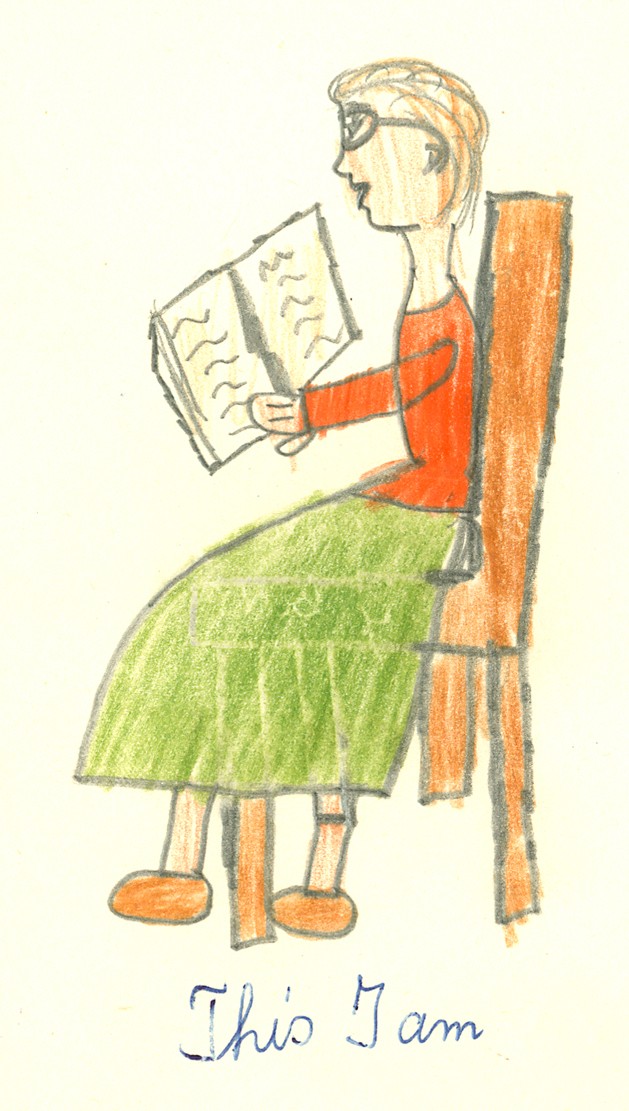 Helga’s self portrait. Courtesy photo
Helga’s letter dated April 15, 1960, underlined more of her colorful life in a bustling German metropolis of over 600,000 people. For example, a traveling performance troupe called the Circus Franz Althoff was about to arrive in Stuttgart. Described as “Europe’s Largest Hippodrome–Circus,” it featured an original act combining four elephants and four palomino horses—and Helga would soon witness that and much more with her parents! How jealous I must have been! Still, she was full of questions about my American hometown, boasting a population of perhaps 15,000. Did I have a boyfriend? Had I ever tasted a drink called Canada Dry? Speaking of Canada, had I ever been there? Well, almost. When I was five years old (1953), our family had set out for Niagara Falls during summer vacation. But then on the car radio, we heard the news that polio was raging in Ontario. Before we even got to the border, my dad turned the car around and headed back home. It would be another two years before the first polio vaccine was even licensed in the U.S., not to mention about 35 years before I saw the falls for the first time myself, along with my spouse and children. At some point I must have told Helga that my mother had studied German in college. As a result, in late July 1960, she sent me a letter written entirely in German. Glancing over her cursive handwriting now, I can quickly make out that she began by thanking me for the “Geburtstagskarte” (birthday card) I had sent her and ended by saying she hoped my mother would be able to translate
what she had written, which as I recall she was able to do without difficulty.
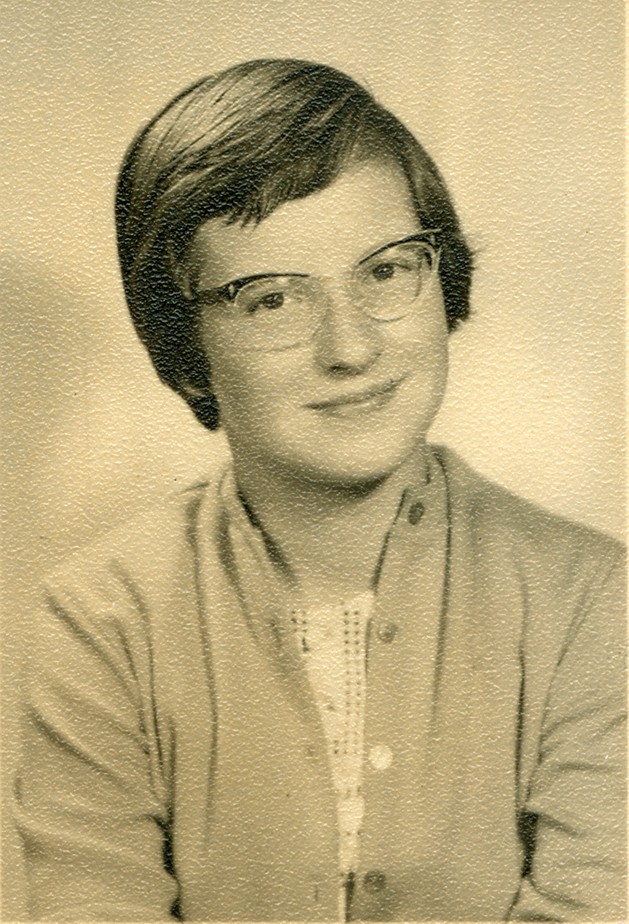
The first photo of Helga that she sent me. Courtesy photo
Helga’s opportunity for international contact comes through repeatedly in her letters. By the age of 13, she had visited Austria four times and Switzerland once. Then in the spring of 1961 she had the chance to spend time and try out her spoken English with a girl named Jill, who was visiting from Cardiff, Wales.
Apparently Jill’s German must have been pretty good, too, since she quickly acquired a boyfriend in Stuttgart while still receiving letters from a boyfriend back home.
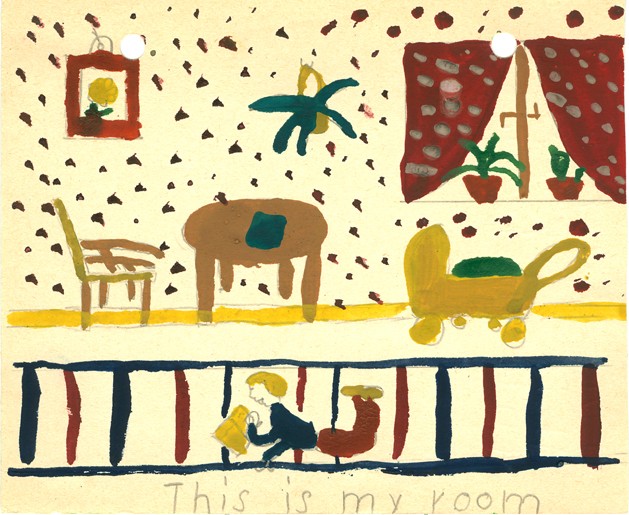 Helga’s drawing of her room. Courtesy photo
One day Helga and Jill visited a newly built Coca–Cola bottling plant where they enjoyed some free samples. Was I familiar with Coca–Cola, Helga wanted to know. And by the way, what kind of music did I like? Helga’s favorite singers were Édith Piaf (one of France’s most widely known international stars during the mid 20th century) and Connie Francis (already a famed recording artist around the world by 1960) whose name I did recognize, even though I seldom listened to popular music. As the summer holidays approached, Helga wrote of learning more about the geography of the U.S. in school. One assignment involved the Ohio River.
Had I ever seen it, she asked, and could a person “swim in it?” Another bit of homework focused on the state of Tennessee, including the cities of Knoxville and Oak Ridge. Now living in Los Alamos, I can’t help wondering how detailed her textbook was concerning the role of either Manhattan Project “secret city” during World War II. She also mentioned the American army base known as Kelley Barracks near her town, one of 40 such installations still in operation today in Germany. When she had visited the base with her parents, she saw “some men playing baseball,” which she understood was as popular in the U.S. as “football” (meaning soccer) was in Germany.
In general up to this time, Helga seldom touched on such delicate topics as twentieth century history and politics. Once she spoke of a new French teacher at her school and did feel compelled to add, “I think you will understand that we do not have much desire to learn French.” In truth, my knowledge of world history, ancient or modern, was pretty much non–existent in elementary school up to then. Though my father had served in the u.s. Army’s Counter Intelligence Corps from 1941–1946 and the Army Reserve until 1956, to my recollection, my parents never really talked much about World War II—at least not in front of my sister and me.
All the same, I do remember watching the CBS Evening News during dinner most nights, with Douglas Edwards first and Walter Cronkite later on. And like many baby boomers, the images of Nikita Khrushchev wielding his shoe at the United Nations in October 1960 and the building of the Berlin Wall in August 1961 still stand out in my memory. Shortly after the latter event, I must have asked Helga something about what was happening in her country because in
November she replied by asking me if I had ever seen JFK in person and noted that she had seen Konrad Adenauer (the first chancellor of West Germany) when he visited her city. She then admitted that the prospect of an attack by the U.S.S.R was very frightening. Although like me, she was born after the war, she must have been well acquainted with the destruction wrought all across Europe from 1939–1945. With guarded optimism, she commented, “we can be thankful that we don’t live in Berlin but in south Germany.”
Despite current events on the world stage, like so many teenagers then and now, Helga’s attention was mainly drawn to her own present and future. For example, she kept up with Elvis Presley’s best selling records and wondered if I knew the song “Travelin’ Man,” that is, Ricky Nelson’s 1961 hit single.
Actually, I was much more familiar with Nelson’s appearance in “The Adventures of Ozzie and Harriet,” one of the longest running sit–coms in U.S. television history, which definitely helped launch their son Ricky’s career as a teen music idol.
Looking further down the road, Helga was beginning to think about what kind of career she might pursue. Having turned 14 during the summer of 1961, she was hoping to find a job for the upcoming Christmas holidays but had also been considering the study of law in the long run, once she had completed her secondary education. Unfortunately, that would have entailed perhaps eight additional years of schooling, which seemed simply overwhelming to her. Similarly on the western side of the Atlantic, after the relative intimacy of a neighborhood elementary school, the challenges of attending a community–wide junior high as well as the thought of the state mandated eighth–grade tests looming in the spring were enough to monopolize the greater part of my consciousness.
All in all, Helga’s mood was much more serious in her letter dated March 30, 1962. This may well have been a result in part of her official “confirmation” less than two weeks earlier, which she described as the “greatest feast in the confessional life of a Protestant.” (See the formal photo from this event.)
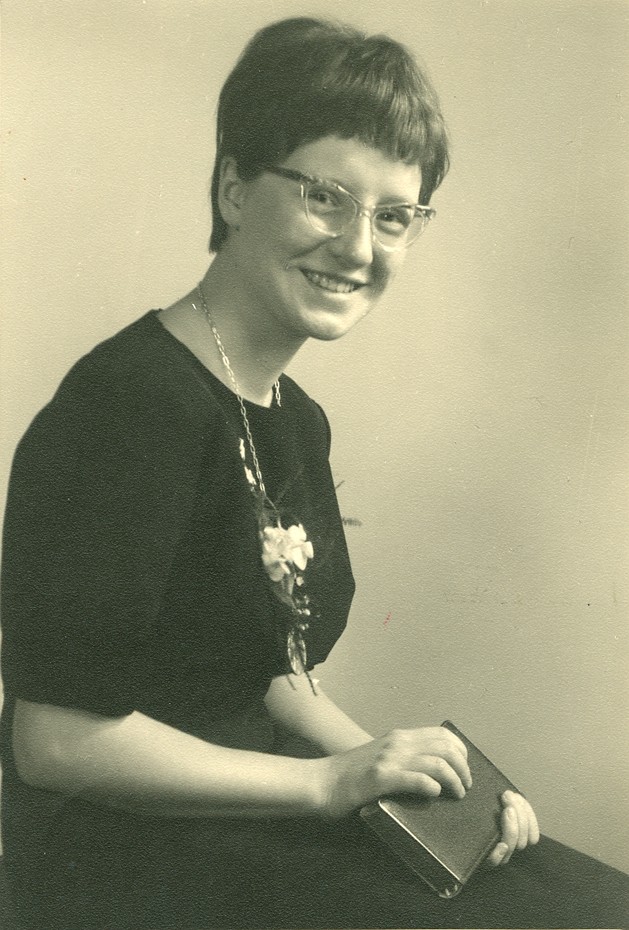
Helga’s confirmation photo. Courtesy photo
Though I was a year younger than she, I had already completed an equivalent process in the Episcopal church in March of 1961. Thinking back now to the catechism I had had to memorize and be tested on by our parish priest over months of preparatory classes, it was, after all, a pretty weighty business to swear that I would “renounce the devil and all his works, the pomps and vanity of this wicked world, and all the sinful lusts of the flesh.”
In any case, Helga suddenly launched into a rather pessimistic description of life in her country: “In Germany many people hunt after money and have no time. They must work very hard to earn enough to buy a television, to buy a car, to build a house. And at the end of life they stand and say ‘My whole life was work. I have nothing, and I have all.’ They buy cigarettes and whiskey, and so on. But for the poor, they have no pity.” Nevertheless, she went on to express the hope of earning much money herself when she was grown up, “not or buying a car, but for traveling in other lands and continents. One day I’ll
come to America to visit you and your family!”
In truth, Helga didn’t just want to visit here. “It must be nice to live in
America, the land of unlimited opportunity.” She understood that the streets were not actually paved with gold, but one of her teachers had resided in the U.S. for some time and assured her students that everything was bigger and better here than in Germany. Of course, for one thing, America had not suffered the same type of ruinous damage during the second world war and by comparison would have seemed a much better place to dwell, especially during the economic boom of the 1950s and 1960s.
Based on the Americans she had met in her home town, Helga was
convinced that they personally felt a greater sense of freedom than most Germans. But then, as she pointed out, Americans had never faced the situation mid–twentieth–century Germans were confronted with, namely, a nation divided, with one part controlled by a foreign power. “You are your own master!” she wrote. “We in West Germany are similar, but for how long? I hope forever!!! Many families have relatives in East Germany. What to do? Never see them again?” I can’t help but wonder what her feelings about the U.S. would be today where extreme political polarization runs rampant, while deep inequities in income, health care, education, and other factors estrange large segments of the population from one another. By contrast, Germany has prospered since becoming a united country in the early 1990s, has developed and maintains a strong social safety net, and is a leader in battling global warming.
I have no idea how I replied to Helga’s comparatively down–hearted letter that spring of 1961, but by July she was much more cheerful. She had been learning how to type at school and for the first time wrote to me on a typewriter. She was looking forward to summer vacation; but before that, her class was to go on a picnic and travel to where Neanderthals had once lived. In August she wrote about the recent launch of Telstar by the U.S. – the world’s first successful communications satellite—and wondered if Khrushchev was sad because the U.S.S.R. had not had the idea first.
Helga penned her next letter to me on October 25, 1962, at the height of the Cuban missile crisis; nevertheless, her faith in the U.S. government remained strong. “I think President Kennedy has done right in enclosing the isle.” Here she refers to the naval quarantine of Cuba, which had begun two days earlier and would not end until Nov. 20. “What luck, that it didn’t become a war! I saw your President speak on television at midnight. It was brought to us by the Telstar. President Kennedy is a famous man, and he speaks very well. Let’s hope that we can live in freedom and peace for the rest of our lives.” All the same, her positive feelings were a bit premature.
Kennedy had delivered a nationwide address on the evening of Oct. 22, announcing the discovery of the missiles by aerial surveillance and stating that, “It shall be the policy of this nation to regard any nuclear missile launched from Cuba against any nation in the Western Hemisphere as an attack by the Soviet Union on the United States, requiring a full retaliatory response.” On Oct. 25 the U.S. raised the readiness level of its Strategic Air Command forces to defcon 2. Tensions continued to mount worldwide and especially inWest Germany, where many feared that the Soviets would insist on occupying West Berlin in exchange for dismantling their nuclear arsenal in Cuba. At length an official agreement between the two superpowers to end the crisis was made public on Oct. 28, whereby the U.S. promised not to invade Cuba if the U.S.S.R. would remove all the missiles and associated equipment previously installed there.
A number of historians believe that the Cuban missile crisis was the closest we have ever come to World War III. Sixty years have gone by now, yet with the Russian invasion of Ukraine on February 24, 2022 and the ongoing widespread death and destruction in that country, some commentators are saying that this may be a rehearsal for the next global conflict. Then, too, as authoritarianism continues to threaten democracy both at home and abroad, it is clear that
the peace and freedom Helga dreamed of so long ago are still by no means guaranteed anywhere.
Another parallel between past and present jumps out from Helga’s letter of February 7, 1963. “Have you seen the American film West Side Story?” she asked. I certainly had, although I don’t recall exactly when. All the same, in hindsight it did seem to have a significant effect on me, albeit somewhat backhandedly. By the time I was in junior high school, I was already pretty sure that classical music would play a major role in my adult life, and this thrilling and contemporary retelling of Romeo and Juliet in the form of a Broadway musical served to bolster that ambition. Moreover, the setting of the story in New York City made me ever more determined to escape from small–town southwestern Ohio and seek my future in the urban Northeast.
Last December, like so many other people, I found myself for the first time in ever so long—pandemic fears be damned—sitting in a movie theater, watching Stephen Sondheim’s take on the 1961 cinematic classic. Reading now about Sondheim’s death just three days before the premiere of the new film at Lincoln Center, knowing that he had written the original lyrics for Bernstein’s powerful musical score, recalling Rita Moreno’s remarkable performance skills back then as Anita and now—at age 90—as Valentina, I’m tearing up again as I did shortly after Christmas, sitting beside my daughter in the dark.
“What’s wrong, Mom? Don’t you like it?” So much time gone by and so many memories, including her own portrayal of Little Red in a high school production of Sondheim’s Into the Woods in 2010.
Returning to Helga’s letter from 1963, I marvel at the other questions she posed, many of which I would have to have answered then in the negative. “Which music do you like in America? Do you know Beethoven, Bach, Håndel, Mozart, etc.? I like very much the 5th Symphony of Beethoven and “Water Music” by Håndel. Do you know Goethe, Schiller, Klopstock, Lessing, etc.? We all in Germany know your famous Hemingway. I would also like to know which painters you have in America. Do you know Pablo Picasso, Vincent van Gogh, Emil Nolde, Kokoschka, Rembrandt, etc.?” In a p.s. she wondered if I was familiar with the music of Ella Fitzgerald, Mahalia Jackson, or Duke Ellington. I was 14; she was 15 but seemed to have already absorbed so much more about the arts, both foreign and domestic, than I would even be exposed to till college or even graduate school. One thing for sure—I was beginning to comprehend the differences in educational priorities between Europe and the U.S.
Page three of that same epistle was equally revelatory but had more to do with the realm of history and Helga’s personal feelings about her homeland.
With no real introduction to the topic, she began: “I have no boyfriend. The girls in my class have none, because you don’t see the boys often except at school or in the dancing hour.” Time out—in elementary school we had learned how to square dance, which substituted for recess in the winter. Something tells me that’s not what Helga was talking about. We were exactly the same, though, in terms of lacking a boyfriend. “I think you Americans are used to living in another way, and you would call our life monotonous. I do, too. But we Germans are used to learning much, to work from morning till evening, to have less money, to be fond of the holidays, to have one time to marry, and I
hate this.”
“I know, American people have to work, too, but I think the Germans still suffer as a result of the second world war. I don’t know whether you know about the very terrible things that happened during the years of Hitler’s government. You may know that normal German people in the towns didn’t know about them. They finally heard about it after Hitler died. I think it is not justice to say all Germans are bad, as some people from other countries do, because you see, they had not known the truth, and our generation wasn’t even born then.”
In closing, Helga asked me to “Excuse please” her long and miserable letter. Since my high school course in world history would not begin until the fall of 1963, I’m certain I had no clear understanding at all of what she had referred to in terms of Hitler and World War II. Most likely I probably just wanted her to cheer up and enjoy her life.
In July 1963 Helga turned 16, and in September she started her last year of secondary school. In late October she wrote, “Next year I’ll take a job. I’ll become an apprentice calculating taxes at a house of finance in Stuttgart under state authority. I’m looking forward to my first salary. Maybe I can save it up for a big journey. My cousin is a sailor. He has already been to El Salvador, Argentina, Brazil, San Francisco, Panama, Australia, and the Suez Canal. Next he’ll go to Spain and England. If I have much money, I’ll travel round the world someday, too.”
The next to last surviving piece of correspondence from my dear pen pal is dated November 27, 1963, just five days after President Kennedy’s assassination. Even after nearly six decades it is difficult to confront that moment in history, but at the same time fascinating to see it from the viewpoint of someone fairly close to me in age yet far enough away geographically to put it into a much wider perspective. Her description of the reaction to his death in her country is still haunting.
“Some days ago we realized clearly that we belong together—West Germany, all of western Europe and the USA.” Honestly, I can’t read this now without thinking of the current and hopefully unrelenting solidarity between the U.S. and Europe in support of Ukraine against Russia’s brutal and unwarranted aggression. “I heard the awful news on television Friday night. Like all Germans, I was shocked. We liked this man, not only for his support of West Berlin but as a human being. I don’t know much about Johnson, but I hope he’ll do as much for the Negroes and the free world as President Kennedy did. Saturday night there was a film on television about John F. Kennedy’s life—the war, his marriage, his children, the days in Germany, his speech on the steps of the Rathaus Schøneberg in Berlin last June when he said, ‘Ich bin ein Berliner,’ and more things. On Monday we saw the funeral service direct from Washington, D.C. Also, we saw how the American soldiers who are stationed in Germany observed this day. A TV reporter asked people in the street about this event, and all said that one of the most important Americans has died. Some wept. Many young people marched silently and carried torches. The spot where Kennedy gave his speech has been renamed John F. Kennedy Place, and many thousands of people gathered there at the time of his funeral. With John Kennedy a new future began. He was a young man and spoke for the young. Germany and especially all people in Berlin are very sad and hope that politics in the free world will continue in the way that our friend John F. Kennedy would have done it.”
Helga’s last letter is dated February 20, 1964. In it she wrote of having only four weeks of school left before her apprenticeship would commence.
She made a point of asking whether or not I would go to college. Apparently that was not an option for her right then. Approaching the age of 17, she was about to enter the world of work and shoulder many of the responsibilities of a grown–up. As for me, two more years of high school lay ahead, plus an ongoing regimen of practice and lessons on the piano, organ, and viola, not to mention three academic degrees in pursuit of a career as a college music teacher and performer. Even so, any remnants of childhood naiveté had surely been washed away on that terrible day in Dallas. In truth, Helga and I were both growing up quickly, whether we wanted to or not.