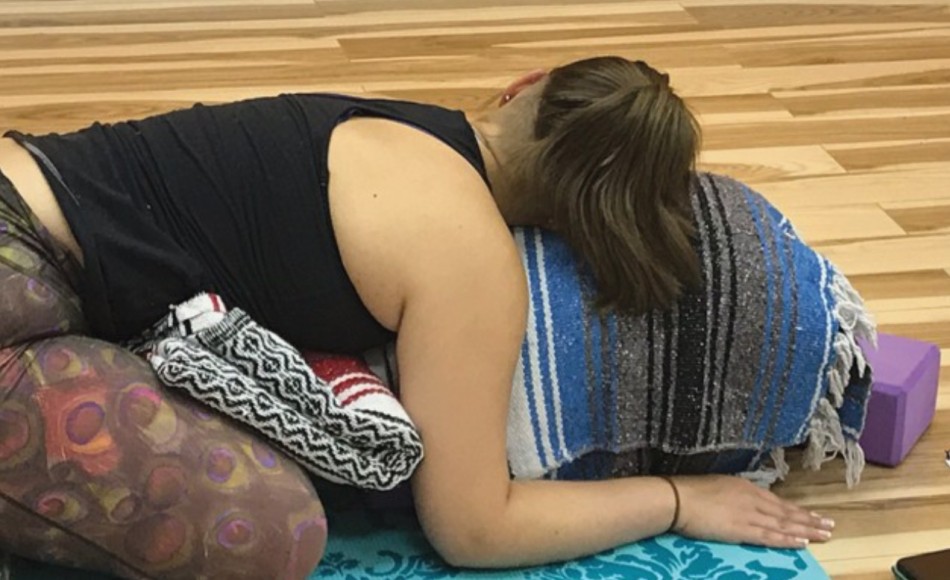
 Restorative yoga is passive and quiet with long rest in each posture from the moment you begin class until the end of final relaxation. Courtesy photo
 By JACCI GRUNINGER, MS, C-IAYT
Los Alamos
Which yoga is best? That is a tough question because they all offer a variety of ways to improve our health and sense of wellbeing in mind, body and spirit. However, recent research of a randomized controlled trial* studied the brain benefits between vinyasa and restorative yoga for breast and ovarian cancer survivors. And restorative yoga, in this study, came out on top.
As someone who enjoys a vigorous vinyasa class now and again but believes the power of yoga is in the breath, slowing down and being present, I was excited to see the results of this research. Restorative Yoga was found to provide significant improvement in overall cognitive function and improvement in what’s called fluid cognitive function – our ability to solve problems and process and integrate information.
Now, it’s important to note that although the vinyasa group didn’t show any significant improvement in cognitive function, they did improve what is called crystallized cognition – the amount of information you have learned over time.
I believe that purposefully being given three hours a week to rest and place the body in yoga postures over supportive props will help anyone, not just cancer patients. We are a highly sleep and rest deprived society. Being given the opportunity to relax could probably help anyone who experiences stress, anxiety and/or illness.
Richard Faulds from the Kripalu Yoga Center says that a traditional yoga class brings us in and out of our sympathetic and parasympathetic systems through faster and slower movement throughout practice. It keeps the brain active because we must stay present to what comes next as well as the possibility of learning new techniques or skills. Final relaxation takes us into a parasympathetic state at the end of class. This is a traditional yoga class format.
Restorative yoga is passive and quiet with long rest in each posture from the moment you begin class until the end of final relaxation.
In addition, when you are in a restorative yoga class, you have the chance to be quiet and still not only on the outside but also on the inside. It can be an opportunity to check in with what’s happening, what you notice and feel and spend some time connecting with those feelings. A vinyasa class moves too quickly for this type of interoception – feeling from the inside out.
Many people think that gentle, chair and restorative yoga aren’t “real” yoga. They believe that real yoga is what you see on the cover of Yoga Journal magazine or yoga that must be fast and vigorous or challenging. Considering that the original yoga was sitting in lotus pose meditating (that’s correct, the original yoga didn’t include any movement) and getting to know yourself, to me, restorative or quiet yoga is just the ticket for healing and connecting.
Again, I believe in all types of yoga and if you only practice one type, you might be missing out on some great benefits. Variety is the spice of life. It’s also nice to know there is new research to support slowing down and being quiet.
*Effects of Vigorous Versus Restorative Yoga Practice on Objective Cognition Functions in Sedentary Breast and Ovarian Cancer Survivors: A Randomized Controlled Pilot Trial
Gary Deng 1, Ting Bao 1, Elizabeth L Ryan 1, Lara Benusis 2, Pasha Hogan 1, Qing S Li 1, Annika Dries 3, Jason Konner 1, Tim A Ahles 1, Jun J Mao 1, Integrative Cancer Therapy, 2022.
About Jacci Gruninger
Jacci Gruninger is a Certified Yoga Therapist, Thai Yoga Massage Therapist, Focusing Coach and Facilitated Stretch Practitioner. She regularly helps clients manage the ups and downs of life with yoga, meditation, breathwork, focusing, stretching and bodywork. Her Yoga Therapy Center is at 190 Central Park Square #212. For her in person and online teaching schedule and information on her other services, visit her website at www.yogawithjacci.com.