







 NNSA Washington, D.C. Courtesy/NNSA
NNSA News:
WASHINGTON, D.C. – As 2014 begins, the National Nuclear Security Administration (NNSA) released a list of some of its most important accomplishments and improvements over the past year. NNSA reached significant milestones in the areas of nonproliferation and counterterrorism, made a host of significant achievements through its work with the United States’ nuclear weapons stockpile, and saw improved operations throughout the complex.
“In 2013, even with a challenging budget situation, NNSA’s successes ensured that the United States’ Read More


 Artist’s conception of JILA’s new technique for measuring the electron’s roundness, or electric dipole moment (EDM). The method involves trapping molecular ions of hafnium fluoride (red and blue spheres, respectively) in spinning electric and magnetic fields. Researchers measure changes over time in the “spin” direction of the molecules’ unpaired electrons (arrows in yellow spheres), which act like tiny bar magnets. Specific patterns in the rate of change, reflecting alterations in the gap between two magnetic energy levels in the molecules,
 Joseph Krol,


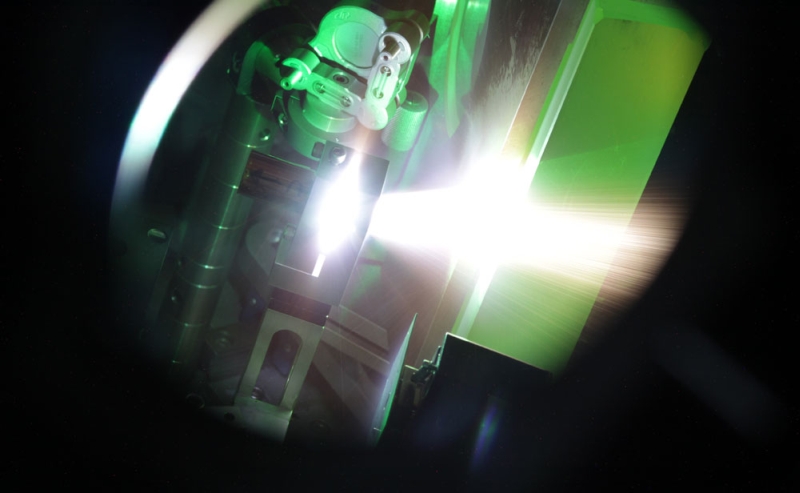 This photo shows a laser pulse at Los Alamos National Laboratory’s TRIDENT facility striking a thin foil target to produce neutrons that can be used to interrogate closed containers and determine the amount and type of hidden nuclear material inside. The technology can be used to thwart nuclear smugglers and is one of several technologies from Los Alamos that are highlighted in this year’s top science stories. Courtesy/LANL